Vietnam is one of the fastest-growing economies globally. Its economy expanded by 8% in 2025, with nominal gross domestic product (GDP) reaching nearly $500 billion. International goods trade has been a key driver of the country’s economic growth, establishing Vietnam as an increasingly important and strategic manufacturing and trading hub in Southeast Asia.
In 2025, total foreign trade volume surpassed $930 billion, an 18% increase from 2024. Both exports and imports recorded strong growth: exports rose 17% to $475 billion, while imports increased by 19% year over year. This momentum also reflects Vietnam's effective utilization of free trade agreements signed with major trading partners.
Key agreements include the Regional Comprehensive Economic Partnership (RCEP), a mega trade agreement that took effect in 2022. It comprises Vietnam, other ASEAN nations, China, South Korea, Japan, New Zealand, and Australia, designed to gradually liberalize and promote trade and investments among members. Vietnam has also signed bilateral free trade agreements: the Vietnam-Japan Economic Partnership Agreement (VJEPA) (in force since 2009), the Vietnam-South Korea Free Trade Agreement (VKFTA) (in force since 2015), and most notably the EU-Vietnam Free Trade Agreement (EVFTA) which came into effect in 2020.
The fundamental role of foreign investment
Foreign-invested enterprises (FIEs) account for a dominant share of Vietnam's foreign trade, highlighting the country's status as a preferred manufacturing hub for global multinationals supplying international markets. In 2025, FIEs contributed 77% of Vietnam's total exports, and 70% of its total goods imports, playing a strategic and pivotal role in the nation’s economic growth.
FIEs are heavily concentrated in manufacturing and industrial production. Most overseas investment projects originate from ASEAN nations, including Singapore, Thailand, and Malaysia; South Korea, Japan, Mainland of China and Taiwan Province; and the United States. South Korean chaebols lead strategic investments, including Samsung, LG Electronics, and Hyundai, alongside global giants like Foxconn, Toyota, Amkor, and Nike. These companies have built manufacturing facilities across Vietnam to serve their global clients.
Heavy reliance on China-sourced materials and components
China is Vietnam's top trading partner, with bilateral goods trade reaching $256 billion in 2025. The relationship features a significant imbalance: Vietnam exported $70 billion worth of goods to China, while imports topped $186 billion.
China remains Vietnam's primary import source, accounting for over 40% of total import value: key imports include computers, electronic devices and components, machinery and raw materials (plastic, metals and textile fabrics). In 2025, Vietnam recorded a $116 billion trade deficit with China.
The U.S.: the main destination for Vietnam-made products
The United States is Vietnam's second largest trading partner, underpinned by strong political relations and economic ties. The U.S. is the top destination for Vietnamese exports, absorbing over $153 billion of Vietnam-made goods – 32% of the country's total exports.
Beyond electronics and machinery, Vietnam's exports to the US include textiles, footwear, toys, games and sport equipment. This underscores Vietnam's critical role for global brands manufacturing goods for the American market.
Strong ties with ASEAN, Japan and South Korea
As an ASEAN member, Vietnam maintains strong economic ties with fellow bloc nations. Exports within ASEAN represent 8% of Vietnam's total exports, led by motor vehicles and automotive parts; Vietnam also sources 12% of its imports from ASEAN neighbors, primarily energy, petroleum and metal components.
Vietnam has emerged as a key investment and production hub for Japanese and South Korean conglomerates, many of which manufacture locally for export to third markets like the U.S. or the European Union.
Major Korean technology firms operate large production plants in Vietnam, making South Korea the country's second-largest import source (13% of total imports).
Leading Japanese automakers have also established manufacturing bases in Vietnam, serving both the domestic market and the broader ASEAN region.
Expanding trade with the European Union
The 27 EU member states offer significant economic opportunities for Vietnam, especially following the EVFTA's entry into force in 2020. The EU ranks as Vietnam's third largest export destination (after the U.S. and China), highlighting its strategic importance for global players manufacturing in Vietnam.
Conclusions
Over the past two decades, Vietnam has evolved into a fast-growing economy, supported by robust infrastructure, a large young and skilled workforce, and rising cross-border investment from multinationals and global brands. These investors have selected Vietnam as a core manufacturing base, leveraging its strong economic ties to the world's leading economies and proximity to China.
Vietnam has become a major global manufacturing center serving international markets, with its economic and trade influence set to expand further in the coming years.
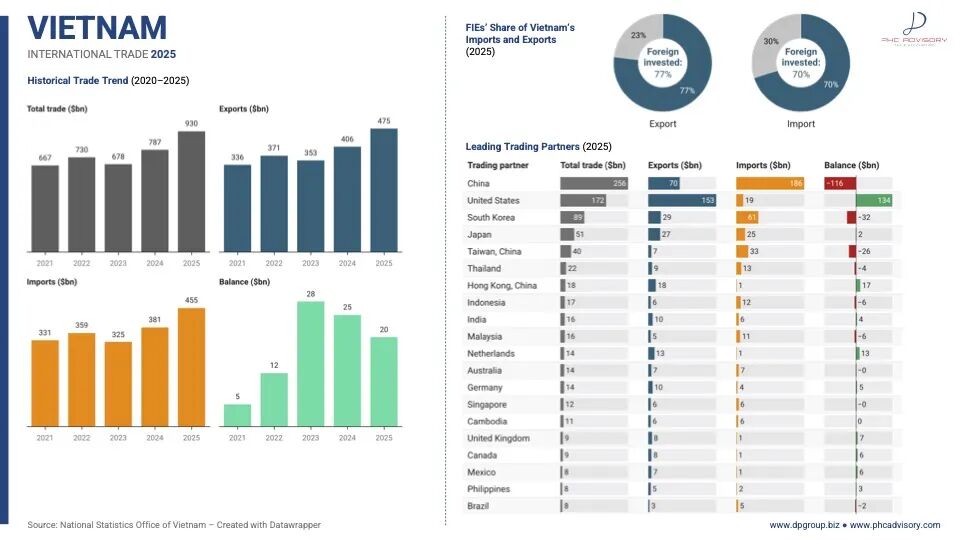


All information and data in the articles and infographics are sourced from the Vietnam National Statistics Office; graphs are created with Datawrapper.
At PHC Advisory, we can offer you full support on matters regarding doing business in China, or any other issues your business may face. If you would like to know more about policies relevant to your business in Italy or Asia, please contact us at info@phcadvisory.com.
PHC Advisory is a company of DP Group: an international professional services conglomerate of companies with approximately 100 experienced professionals worldwide. We offer comprehensive services in tax, accounting, and financial consulting, including financial supervision, financial audit, internal audit, internal control over financial reporting, and support for audited financial statements and annual audits, ensuring clients' financial transparency and compliance.
Would you like to learn more about the business environment in China? Click the link and download our Practical Guides on Amazon!
The content of this article is provided for informational purposes only, financial advice must be tailored to the specific circumstances on a case-by-case basis, and the contents of this article do not legally bind PHC Advisory with the reader in any way.